Gas Line Repair in Trace, San Marcos, TX
Trace is a newer master-planned community in south San Marcos, rising at Posey Road and I-35 on 420 acres that were open ground not long ago. Its streets are lined with contemporary single-family homes, the Presidio amenity center, and phases that are still filling in. Gas systems here are thoroughly modern — gas cooktops, gas water heating, outdoor living stubs — and they fail in modern ways. We provide careful, code-aware gas line repair, installation, and leak detection across Trace, with work planned around new-lot settlement, builder-installed piping, and the outdoor additions homeowners make after move-in.
About this area
Why gas line repair in Trace matters
Why we serve here
Trace sits where the south side of San Marcos is still taking shape — a large master-planned community of contemporary homes on land that was pasture and prairie a few years back. New construction means modern, code-built gas systems, but it also brings settling fill pads, irrigation trenches crossing buried lines, and homeowners adding fire pits and outdoor kitchens after closing. We serve Trace because young neighborhoods develop their own gas-line patterns — and catching them early keeps small issues from becoming expensive ones.
In Trace, the gas lines are new — and new systems have their own failure patterns
Before Trace was a neighborhood, it was open Blackland Prairie at the corner of Posey Road and I-35, south of the San Marcos outlet malls. Today it is a 420-acre master-planned community with roughly a thousand single-family homes plus multifamily sections, the Presidio amenity center with its resort-style pool and sport courts, and Rodriguez Elementary serving San Marcos CISD families. The gas infrastructure is as young as the rooftops: polyethylene service lines, modern interior piping, gas cooktops, and gas-fired water heating installed during construction. That youth changes the diagnostic picture completely. Instead of decades of corrosion, Trace gas problems come from the things new neighborhoods do — lots settling on graded fill, landscaping crews trenching across buried runs, and homeowners tapping into systems for outdoor living the builder never planned for.
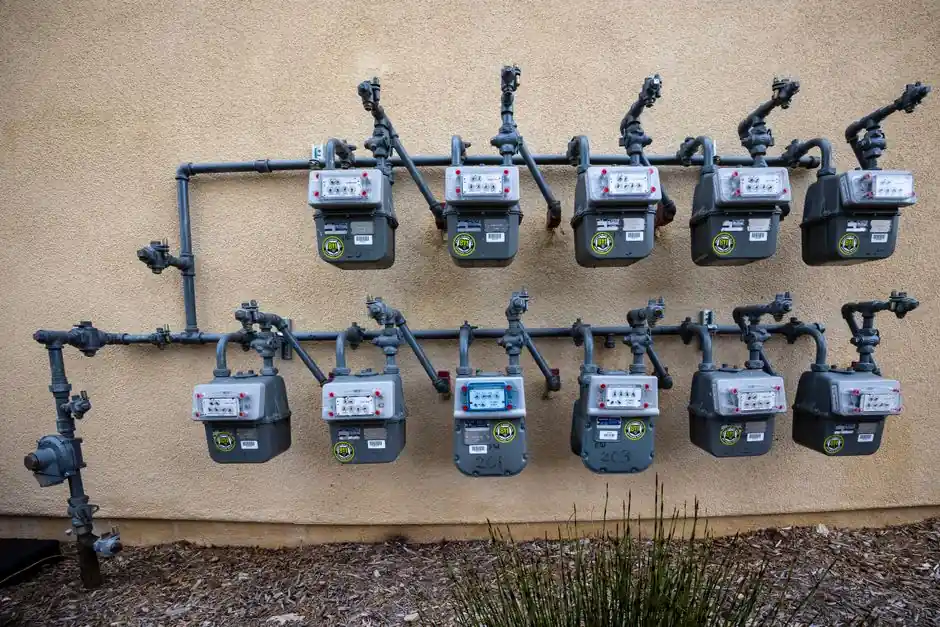
The housing mix tells the construction story. Multiple builders — Brohn, D.R. Horton, Chesmar among them — have put up three-to-five-bedroom single-family homes across successive phases, each phase graded, trenched, and piped by different crews on a different schedule. Gas meter sets line the sides of these homes in neat rows, with service lines running under fresh sod to the street. Because phases were built years apart, a 2018 home and a 2024 home on the same street can have meaningfully different installation details. When we work in Trace, we read each house like its own construction document: how its phase was graded, where its service was routed, and what the original crew left us to work with.
Under every Trace lot sits Blackland Prairie clay — and on newly graded lots, that clay has been cut, filled, and recompacted. Fill pads settle unevenly over their first several years, and buried gas pipe settles with them. The stress concentrates where the pipe cannot move: at risers, at meter connections, and at fittings where the line enters the home. Meanwhile the same clay swells hard after spring storms and shrinks through summer drought, so a line bedded in disturbed fill gets worked from both directions. Add irrigation trenching — new lawns mean new sprinkler lines, often dug with no knowledge of where gas runs — and you have the signature Trace combination: young pipe in restless ground, crossed by shallow trenches nobody mapped.
A year in Trace puts the gas system through a full Central Texas workout. Spring brings heavy storms that saturate new lots whose drainage patterns are still establishing; water pooling against foundations and meter sets is the season's warning sign. Summer drought then shrinks the clay away from pipe bedding, opening small voids that let lines shift and stressing riser connections. Fall is the calm inspection window — the right time for a pressure test and a walkthrough before heating season. Winter brings the rare hard freeze, and newer homes with exposed outdoor risers, grill stubs, and pool equipment lines are the ones that need freeze awareness most. Each season writes its own chapter on a young gas system, which is why we treat Trace as a year-round maintenance story rather than a one-time fix.
The signature Trace project is the after-market outdoor addition. Fire pits, outdoor kitchens, built-in grills, and pool heaters get added after move-in — often by landscape contractors or handymen who tap the nearest gas line without calculating whether it can carry the new load. A cooktop, a tankless water heater, and a new fire pit can quietly exceed what the original branch was sized for, and the symptom looks like a mystery: flames that drop when everything runs at once. Beyond the backyards, the Presidio amenity center and its pool heaters and pavilion grills represent community-scale gas loads with their own maintenance rhythm. Our approach in Trace starts with verification, not assumptions: we pressure-test to establish a baseline, size every addition against the actual load, coordinate Texas811 utility locating before any digging, and handle permits and inspections wherever they apply. New neighborhoods deserve documentation from day one, and we leave every job with it.
Services available
Gas line repair services in Trace
Trace homes need gas line work shaped by new construction: verifying builder-installed runs against settlement and time, adding properly sized gas for outdoor living, upgrading lines for equipment like tankless water heaters, and detecting leaks on systems young enough that nobody suspects them yet. We handle all of it — from the meter to the fire pit — with diagnosis first, digging second, and clear documentation throughout.
Gas Line Repair
Gas line repair in Trace often means finding the one fitting or section that did not survive new-lot settlement — a stressed riser connection, a joint worked loose in fill, a branch nicked during landscaping. We pressure-test in segments to isolate the problem, expose only what the tests point to, and repair or replace with materials suited to modern systems and restless clay. Every repair is retested before gas is restored, and you get a record of what was found and fixed.
Gas Line Installation
From outdoor kitchens and fire pits to grill stubs, pool heaters, and gas lines for new construction phases, we size and route new piping for Trace properties. Every run is calculated against the actual load it will carry — including everything already on the system — buried at proper depth through graded clay, and installed to current code with pressure testing and documentation before it goes into service.
Gas Leak Detection
New systems can leak too, and in Trace the causes are installation-era: fittings stressed by settlement, risers bumped by edgers and mowers, connections disturbed during landscape projects. We combine electronic gas detection with pressure testing to find leaks at risers, along buried runs, and around outdoor additions, then give you a straight account of what is leaking, where, and what it will take to fix.
How we work locally
How gas line repair is executed in Trace
Challenge: New-lot settlement stressing buried connections
Trace lots were graded from cut-and-fill within the last several years, and fill settles unevenly as it compacts. Buried gas lines ride that settlement — and the stress lands on the parts that cannot move: risers, meter connections, and fittings at the house wall. A line that tested perfectly at final inspection can develop a weeping joint two years later for no reason other than the ground beneath it finishing its settling.
Challenge: After-market outdoor gas additions without proper sizing
Fire pits, outdoor kitchens, and built-in grills are the most popular post-move-in projects in Trace — and many are connected by whoever built the patio, with no load calculation and no permit. Tapping an existing branch for a 60,000-BTU fire pit can starve the cooktop and water heater, and the result looks like a mystery: appliances that misbehave only when everything runs together.
Where we work
Case files
Sage Meadows Drive — cooktop and tankless starving under combined load
A family in a newer Trace home noticed the gas cooktop flames dropping whenever the tankless water heater fired during heating season. The home was only a few years old, so a gas problem was the last thing they suspected — but combined demand was exposing an undersized branch run to the kitchen, installed during original construction.
We mapped the connected load across every gas appliance and pressure-tested the system in segments. The branch serving the kitchen could not carry the cooktop plus the tankless unit at full fire. We replaced that branch with a correctly sized run, routed cleanly and pressure-tested before reconnection, with no changes needed to the rest of the young system.
The cooktop now holds a steady flame with every appliance running, the family has a documented load calculation for future additions, and the fix touched only the one undersized branch — not the whole system.
Backyard on Silent Bird Lane — gas for a new outdoor kitchen
Homeowners wanted a built-in grill and fire pit in their backyard, but the patio contractor's plan was to tee off the nearest interior line with no sizing math and no permit. The existing branch was already carrying the cooktop and water heater, and the homeowners asked us to check before anyone cut pipe.
We calculated total connected load, confirmed the existing branch could not carry the new features, and ran a dedicated line from the meter along a route clear of irrigation and the new patio footings. Texas811 locating was coordinated before trenching, the work was permitted and inspected, and the line was pressure-tested before the grill and fire pit were connected.
The outdoor kitchen runs at full output with the house appliances going, the installation is permitted and documented for resale, and the yard was restored with only a narrow, planned trench line.
Field evidence from Trace
New-community gas work: verify first, then upgrade
Trace rewards a contractor who reads new construction like a map. We have verified builder-installed runs against settlement, sized outdoor kitchens and fire pits that patio crews wanted to wing, traced weeping fittings back to fill-pad movement, and given young homes the baseline documentation they never had. The pattern is consistent: pressure-test to establish the truth, size every addition against the real load, and never assume a new system is a sound system. In a community still being built, that discipline is what keeps small installation-era issues from becoming big homeowner problems.
Local questions
Should I have the gas system inspected in my newly built Trace home?
Yes — and the reason is not that builders do poor work, but that new lots keep moving after closing. Fill-pad settlement, landscape trenching, and irrigation installs all happen in the first years, and each can affect buried piping. An inspection with a pressure test establishes a baseline: it confirms the system holds, documents the visible piping, and gives you a record to compare against if anything changes. Think of it as the gas equivalent of a foundation check on a new home.
Can I add a gas fire pit or outdoor kitchen to my Trace home?
In most cases, yes — but it needs to be done as a gas project, not a patio afterthought. The connected load of the new features must be calculated against the capacity of your existing system, and a dedicated, properly sized line is usually the right answer. Permits and inspections apply, Texas811 locating is coordinated before any trenching, and it is worth checking your community guidelines before construction starts. Done correctly, the addition is safe, permitted, and documented for resale.
What factors affect the cost of gas line work in Trace?
New-community jobs are shaped by access and scope: the length and depth of the run, how much established landscaping must be worked around or restored, the load calculation for additions, and the condition of the builder-installed piping being tied into. Permit and inspection requirements apply depending on the work. A proper on-site assessment is the only way to price the actual job, so treat any quote given without a site visit with skepticism.
Does the Presidio amenity center's gas equipment affect my home's gas service?
No — amenity-center gas loads like pool heaters and pavilion grills are served by separate commercial accounts and piping, not by residential service lines. Your home's system is independent of the community's common-area equipment. That said, the amenity center is a good reminder that gas infrastructure in Trace is extensive; if you ever smell gas near common areas, report it to community management and the gas utility right away, just as you would at home.
Safety & compliance
Trust and compliance
In a community as new as Trace, it is tempting to assume the gas system is fine because the house is. We do not work on assumptions. Every job follows current fuel-gas code requirements, permits and inspections are handled where they apply, Texas811 locating is coordinated before any excavation, and every repair is pressure-tested before gas is restored. New neighborhoods deserve the same rigor as old ones — arguably more, because no one has checked these systems since the day they were installed.
Signs you need gas line repair in Trace
In a young neighborhood like Trace, gas trouble rarely announces itself loudly — the systems are new enough that nobody is watching for it. Knowing what to look for is how you catch installation-era issues while they are still small.
1. A gas odor anywhere on the property
The rotten-egg smell added to natural gas means act now, not later. In Trace it may show up near a riser stressed by settlement, around a new outdoor gas feature, or along a buried run disturbed by landscaping. Ventilate, avoid flames and switches, and call for professional help — new systems deserve the same urgency as old ones.
2. Cooktop flames that drop when other appliances run
If the range flames shrink every time the water heater fires or the furnace kicks on, the branch serving the kitchen may be undersized for the home's real combined load — a classic new-construction sizing miss. It is not a faulty appliance; it is a capacity problem, and a load calculation plus pressure test will confirm it.
3. A struggling strip of new sod along the buried line's path
A line of yellowing or dying grass running from the meter toward the house — especially on a lawn that is otherwise thriving — is a textbook sign of a buried leak starving roots of oxygen. On fresh Trace sod it stands out clearly, and it is worth investigating promptly.
4. A riser or meter connection that has shifted or started to lean
Walk past your meter now and then. If the riser leans, the connection looks strained, or fittings show fresh corrosion after lot settlement or nearby landscape work, the buried line is telling you the ground moved. A leaning riser is an inspection trigger, not a wait-and-see item.
5. An outdoor gas feature with a weak or uneven flame
A fire pit or grill that never quite roars — or one zone of an outdoor kitchen that underperforms — often traces back to an undersized tap or a restriction in the addition's piping. If the feature never worked right from day one, the installation math was probably never done.
6. Irrigation or landscape trenching planned across your yard
Before any contractor digs for sprinklers, drainage, or a patio, have the gas line's path located and marked. Most accidental gas line strikes in new communities happen during landscape projects, not construction — and a locate call costs nothing compared to a struck line.
Reliable gas line repair in Trace
Whether it is a new-build system that has never had a baseline inspection, an outdoor kitchen waiting on properly sized gas, or a leak nobody expected in a young neighborhood, Trace's gas systems deserve diagnosis before digging. Call today for careful, code-aware gas line repair, installation, and leak detection anywhere in the community.
Request service